

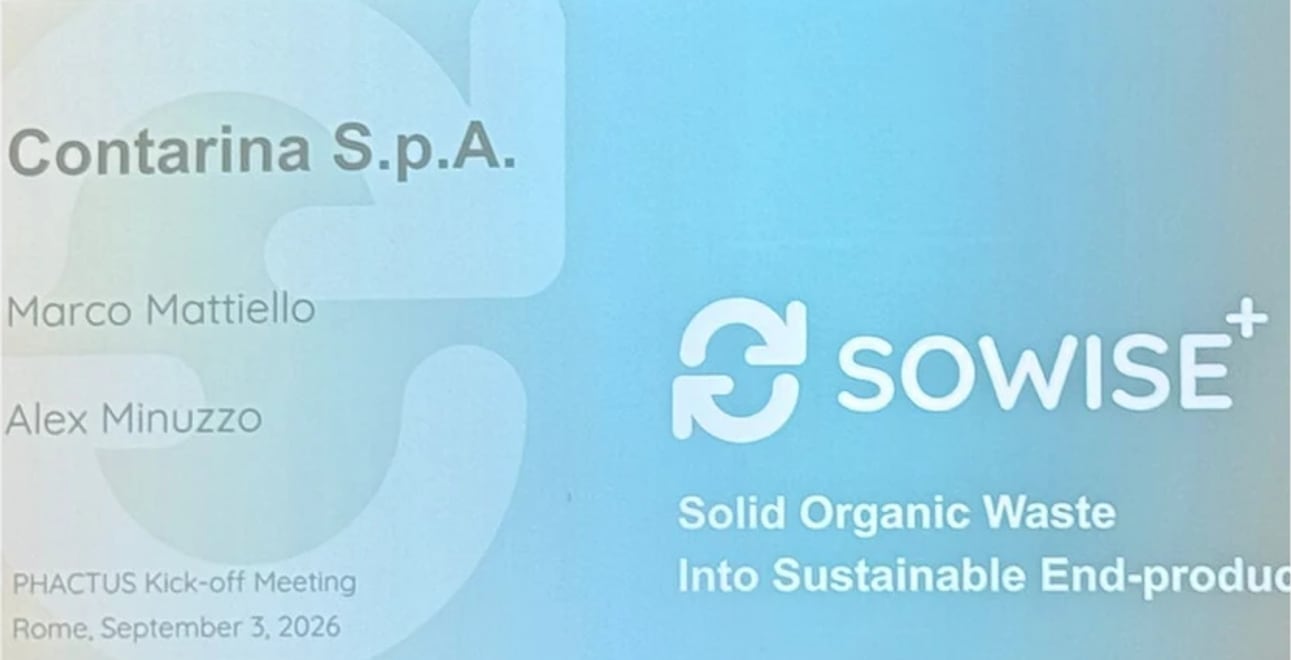
Connecting European projects and exchanging knowledge are important steps towards accelerating innovation in the circular bioeconomy. In this context, SOWISE+ was represented at the Kick-off Meeting of the European project PHACTUS, held on 3–4 September 2026 at Sapienza University of Rome, Italy.
During the meeting, Marco Mattiello from Contarina S.p.A., Project Coordinator of SOWISE+, presented the project and its ambition to transform urban waste streams into valuable bio-based materials through a first-of-its-kind multipurpose biorefinery.
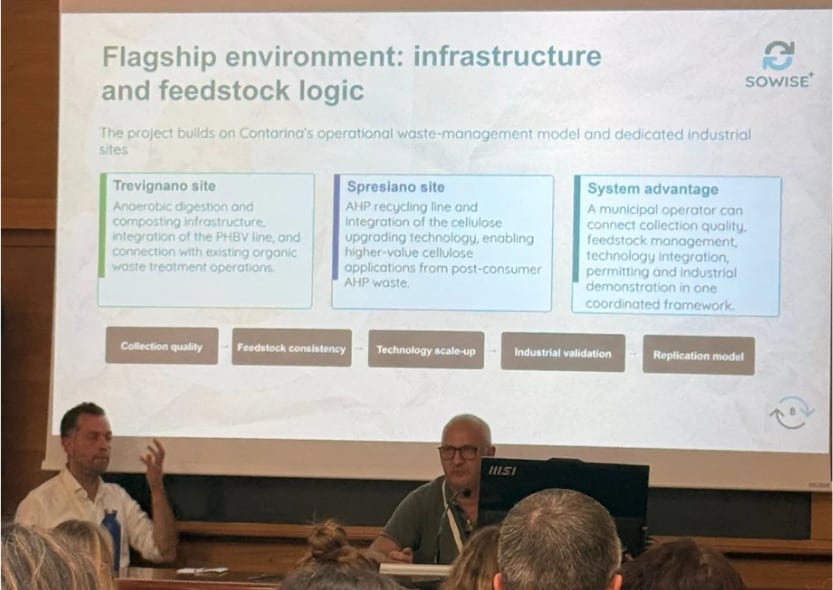
Introducing the SOWISE+ approach to the PHACTUS community provided an opportunity to share the project’s vision and explore common areas of interest between European initiatives working on circular waste valorisation and bio-based materials.
PHACTUS: advancing PHA production from urban waste
PHACTUS – PHA through continuous, Tunable, Safe and Sustainable production – brings together 20 international partners and aims to develop an innovative biotechnology process at pilot scale (TRL 6).
The project focuses on converting urban organic waste and sewage sludge into biodegradable PHA polymers, with potential applications in sectors including construction, agriculture and packaging.
This creates a strong thematic connection with SOWISE+, which is also working on innovative pathways for transforming urban waste into valuable resources and advancing the production and application of PHA-based materials.
Building synergies across the circular bioeconomy
The participation of SOWISE+ in the PHACTUS Kick-off Meeting highlights the importance of collaboration and knowledge exchange between European research and innovation projects.
By sharing experiences, technical knowledge and approaches, projects working within the same ecosystem can identify opportunities for future synergies and contribute to a stronger European circular bioeconomy community.
SOWISE+ looks forward to continuing the dialogue with PHACTUS and other European initiatives working towards more sustainable, circular and resource-efficient value chains.